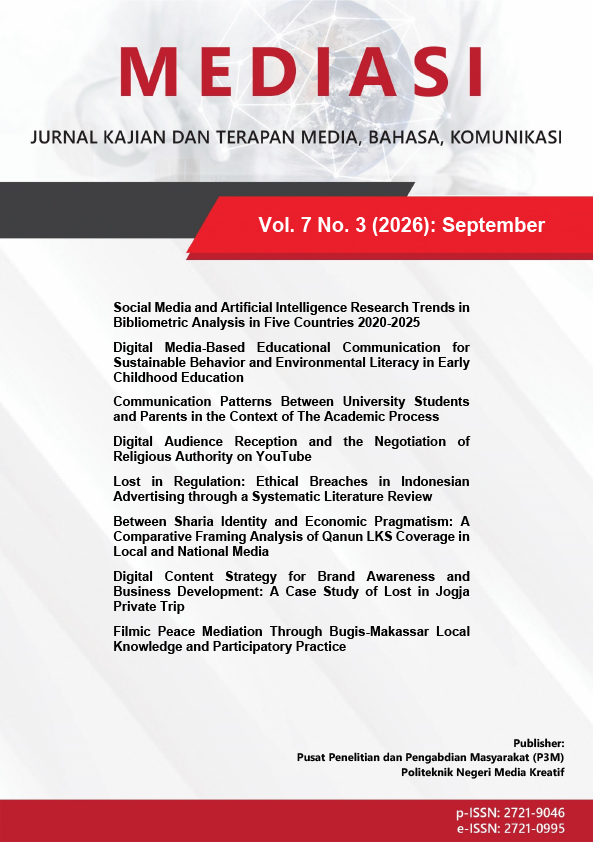
Social Media and Artificial Intelligence Research Trends in Bibliometric Analysis in Five Countries 2020-2025
DOI:
https://doi.org/10.46961/mediasi.v7i3.1994Keywords:
Trend, Social Media, Bibliometric Analysis, Countries, Artificial IntelligenceAbstract
Technological developments. Recently, the use of social media and advances in artificial intelligence (AI) have driven an increase in academic research. While a large number of bibliometric studies have addressed social media and AI separately, few have addressed how these two disciplines are comparatively integrated across countries. The purpose of this analysis is to examine publication trends, thematic structures, and collaboration patterns in AI and social media research across five countries: the United States, China, the United Kingdom, South Korea, and Indonesia from 2020 to 2025. The method used is a bibliometric analysis of 237 journal articles indexed by Scopus and analyzed using VOSviewer and Biblioshiny-R. The results show a significant increase in the number of publications, from 12 articles in 2020 to 98 articles in 2025. The United States and China are the main contributors and hubs of global research collaboration. The most dominant themes include machine learning, sentiment analysis, social media, generative AI, ChatGPT, and AI ethics. The results show that the research focus has shifted from technical issues to issues such as digital governance, ethics, mental health, and social issues. This study offers an in-depth overview of developments in AI and social media analytics. It identifies remaining research opportunities, particularly related to AI ethics, digital platform governance, and increasing the involvement of developing countries in international research collaborations.
References
Akpabio, E., Narad, S., & Ulhe, P. (2024). The Evolution and Impact of Artificial Intelligence its Applications, Challenges, and Future Directions: A Review. 2024 International Conference on Artificial Intelligence and Quantum Computation-Based Sensor Applications, ICAIQSA 2024 - Proceedings. https://doi.org/10.1109/ICAIQSA64000.2024.10882203
Alderete, M. V. (2026). Cross-country gaps in artificial intelligence: Factors explaining digital inequality. Information Development. https://doi.org/10.1177/02666669261418654
Arawi, T., El Bachour, J., & El Khansa, T. (2024). The Fourth Industrial Revolution: Its Impact on Artificial Intelligence and Medicine in Developing Countries. Asian Bioethics Review, 16(3), 513–526. https://doi.org/10.1007/s41649-024-00284-7
Baas, J., Schotten, M., Plume, A., Côté, G., & Karimi, R. (2020). Scopus as a curated, high-quality bibliometric data source for academic research in quantitative science studies. Quantitative Science Studies, 1(1), 377–386. https://doi.org/10.1162/qss_a_00019
Bala, R., & Rani, S. (2025). The Social Media Dilemma: Exploring the Dual Effects of Digital Connectivity. In Psychology and Intricacies in Social Media Interactions: A Critical Perspective (pp. 313–327). https://doi.org/10.1201/9781003614326-18
Bikku, T., Biyyapu, N. S., Sekhar, J. C., Kumar, M. K., Nokerov, S. M., & Pratap, V. K. (2024). The Social Network Dilemma: Safeguarding Privacy and Security in an Online Community. International Journal of Safety & Security Engineering, 14(1). https://doi.org/https://doi.org/10.18280/ijsse.140112
Camilleri, M. A. (2024). Artificial intelligence governance: Ethical considerations and implications for social responsibility. Expert Systems, 41(7), e13406. https://doi.org/https://doi.org/10.1111/exsy.13406
Chen, T., Hernandez, M., & Esteve, M. (2024). The Adoption and Implementation of Artificial Intelligence Chatbots in Public Organizations: Evidence from U.S. State Governments. American Review of Public Administration, 54(3), 255–270. https://doi.org/10.1177/02750740231200522
Clarke, J., Chen, H., Du, D., & Hu, Y. J. (2021). Fake news, investor attention, and market reaction. Information Systems Research, 32(1), 35–52. https://doi.org/10.1287/isre.2019.0910
D’Cruz, P., Du, S., Noronha, E., Parboteeah, K. P., Trittin-Ulbrich, H., & Whelan, G. (2022). Technology, Megatrends and Work: Thoughts on the Future of Business Ethics. Journal of Business Ethics, 180(3), 879–902. https://doi.org/10.1007/s10551-022-05240-9
Darda, P., & Pendse, M. K. (2025). The impact of artificial intelligence (AI) transformation on the financial sector from the trading to security operations. In Shaping Cutting-Edge Technologies and Applications for Digital Banking and Financial Services (pp. 322–339). https://doi.org/10.4324/9781003501947-20
De Paulo, A. F., & Brambilla, G. F. (2025). Artificial Intelligence and Decision-Making: A Bibliometric Study Based on the Scopus. Journal of Information and Knowledge Management, 24(4). https://doi.org/10.1142/S0219649225500352
Elharbaoui, E., & Ntebutse, J. G. (2025). Artificial Intelligence and University Education: Bibliometric Analysis of Research Trends and Perspectives. Canadian Journal of Learning and Technology, 51(1). https://doi.org/10.21432/cjlt28788
Fitriani, Y. (2021). Pemanfaatan media sosial sebagai media penyajian konten edukasi atau pembelajaran digital. Journal of Information System, Applied, Management, Accounting and Research, 5(4), 1006–1013. https://doi.org/https://doi.org/10.52362/jisamar.v5i4.609
Giridhar, A., Ravi, A., Anjan Kumar, R., Charan, B., & Vanamala, H. R. (2025). Detecting AI-Generated Artwork: An Ensemble Model for Enhancing Visual Authenticity in the Digital Age. Proceedings of 8th International Conference on Inventive Computation Technologies, ICICT 2025, 475–481. https://doi.org/10.1109/ICICT64420.2025.11004722
Hao, H., & Wang, Y. (2020). Leveraging multimodal social media data for rapid disaster damage assessment. International Journal of Disaster Risk Reduction, 51. https://doi.org/10.1016/j.ijdrr.2020.101760
Kim, D. (2025). Comparative analysis of AI innovation systems in the U.S. and South Korea. Issues in Information Systems, 26(1), 279–295. https://doi.org/10.48009/1_iis_121
King, T. C., Aggarwal, N., Taddeo, M., & Floridi, L. (2020). Artificial Intelligence Crime: An Interdisciplinary Analysis of Foreseeable Threats and Solutions. Science and Engineering Ethics, 26(1), 89–120. https://doi.org/10.1007/s11948-018-00081-0
Kong, L., Liu, Z., Pan, X., Wang, Y., Guo, X., & Wu, J. (2022). How do different types and landscape attributes of urban parks affect visitors’ positive emotions? Landscape and Urban Planning, 226. https://doi.org/10.1016/j.landurbplan.2022.104482
Lian, Y., Tang, H., Xiang, M., & Dong, X. (2024). Public attitudes and sentiments toward ChatGPT in China: A text mining analysis based on social media. Technology in Society, 76. https://doi.org/10.1016/j.techsoc.2023.102442
Lohrke, F. T. (2025). Social media platforms. In Elgar Encyclopedia of Entrepreneurship and Digitalization (pp. 284–288). Edward Elgar Publishing Ltd. https://doi.org/10.4337/9781035319299.00064
Maharani, S., Lutpiani, A., & Setiawan, A. (2025). Social Media: A Bibliometric Analysis. International Journal of Engineering, Science and Information Technology, 5(2), 462–473. https://doi.org/10.52088/ijesty.v5i2.880
Mellouli, S., Janssen, M., & Ojo, A. (2024). Introduction to the Issue on Artificial Intelligence in the Public Sector: Risks and Benefits of AI for Governments. Digital Government: Research and Practice, 5(1). https://doi.org/10.1145/3636550
Meshi, D., & Ellithorpe, M. E. (2021). Problematic social media use and social support received in real-life versus on social media: Associations with depression, anxiety and social isolation. Addictive Behaviors, 119, 106949. https://doi.org/https://doi.org/10.1016/j.addbeh.2021.106949
Mseer, I., & Samhan, A. A. A. (2025). Social Media: Increasingly Interconnected World. In Studies in Systems, Decision and Control (Vol. 586, pp. 1375–1381). https://doi.org/10.1007/978-3-031-87550-2_91
Niankara, I., & Gnegne, Y. (2025). Mapping the Intellectual Structure and Emerging Trends in Artificial Intelligence Applications to Social Network Analysis: A Bibliometric and Network Perspective (2010-2024). In E. K. & J. Y. (Eds.), International Conference on Social Networks Analysis, Management and Security, SNAMS (Issue 2025, pp. 124–131). Institute of Electrical and Electronics Engineers Inc. https://doi.org/10.1109/SNAMS67467.2025.11391230
Pavlíček, A. (2025). Ai Innovations - The Double-Edged Sword: Exploring Positive And Negative Implications Of Artificial Intelligence In Social Media. IDIMT 2025 - ICT in Business: AI Everywhere? Glory and Disgrace of AI - 33rd Interdisciplinary Information Management Talks, 257–268. https://doi.org/10.35011/IDIMT-2025-257
Pokharel, B. P., Kshetri, N., Sharma, S. R., Paudel, S. R., & Baral, S. (2025). blockAuth: A Blockchain-Driven Framework for Verifiable Content Creation and Secure Distribution in the Generative AI Era. In Securing AI-Generated Media With Blockchain Technologies (pp. 99–135). IGI Global. https://doi.org/10.4018/979-8-3373-6481-0.ch004
Randisa, A. R., Asriadi, A., & Sari, I. (2025). The Development of Social Media Trends in Public Participation: A Bibliometric Visualization Using VOSViewer. Jurnal Noken: Ilmu-Ilmu Sosial, 11(2), 493–508. https://doi.org/https://doi.org/10.33506/jn.v11i2.5088
Robinson, R. J., & Taki, A. (2025). Web Network and Mobile App Authentications Enhancing Social Media Security. In Signals and Communication Technology: Vol. Part F1008 (pp. 127–141). https://doi.org/10.1007/978-3-032-03632-2_10
Sanjaya, R. (2025). Tren Penelitian Artificial Intelligence dalam Bidang Sosial dan Humaniora: Kajian Scientometrika Pada Database Scopus Tahun 2015–2025. HUMANIS: Jurnal Ilmu-Ilmu Sosial Dan Humaniora, 17(2), 193–205. https://doi.org/https://doi.org/10.52166/humanis.v17i2.9498
Selvakumar, P., Prasanna, L., Malik, N., & Chaudhry, R. (2025). Social media and technological advancements. In Sustainable Practices in the Fashion and Retail Industry (pp. 419–439). IGI Global. https://doi.org/10.4018/979-8-3693-9959-0.ch018
Shafik, W. (2025). Social Media Marketing in the Age of Artificial Intelligence: TikTok’s AI Algorithms Driving Customer Engagement. In Enhancing Intergenerational Social Connections Using Shared Common Values (pp. 195–222). IGI Global. https://doi.org/10.4018/979-8-3373-4367-9.ch008
Smith-Mutegi, D., Mamo, Y., Kim, J., Crompton, H., & McConnell, M. (2025). Perceptions of STEM education and artificial intelligence: a Twitter (X) sentiment analysis. International Journal of STEM Education, 12(1). https://doi.org/10.1186/s40594-025-00527-5
Tuncay, N. (2025). The 10-Year Shift: How AI Reshaped Social Media From 2014 to 2024. Proceedings of the 12th European Conference on Social Media, ECSM 2025, 282–291. https://www.scopus.com/inward/record.uri?eid=2-s2.0-105011588366&partnerID=40&md5=bff69ebf6e29cfac0fcfbcfa9f08fc9a
Tyagi, A. K., Lakkshmanan, A., & Ahmad, S. S. (2024). The future of Artificial Intelligence and Machine Learning in online social networking. In Online Social Networks in Business Frameworks (pp. 201–226). wiley. https://doi.org/10.1002/9781394231126.ch9
Verma, A., Priyanka, P., Khan, T., Singh, K., Yesufu, L. O., Mohd Ariffin, M. M., & Ahmadian, A. (2025). ScrutNet: a deep ensemble network for detecting fake news in online text. Social Network Analysis and Mining, 15(1). https://doi.org/10.1007/s13278-025-01412-3
Wang, B., Rau, P.-L. P., & Yuan, T. (2023). Measuring user competence in using artificial intelligence: validity and reliability of artificial intelligence literacy scale. Behaviour and Information Technology, 42(9), 1324–1337. https://doi.org/10.1080/0144929X.2022.2072768
Wang, Z., Li, M., Lu, J., & Cheng, X. (2022). Business Innovation based on artificial intelligence and Blockchain technology. Information Processing and Management, 59(1). https://doi.org/10.1016/j.ipm.2021.102759
Zejjari, I., & Benhayoun, I. (2024). Bibliometric Analysis of Artificial Intelligence in Marketing: Revealing Publication Trends Using Bibliometrix R-Tool. In Contributions to Management Science: Vol. Part F3767 (pp. 737–750). https://doi.org/10.1007/978-3-031-67531-7_59
Zhang, J., & Zhang, Z. (2024). AI in teacher education: Unlocking new dimensions in teaching support, inclusive learning, and digital literacy. Journal of Computer Assisted Learning, 40(4), 1871–1885. https://doi.org/10.1111/jcal.12988
Zhu, M., & Wang, C. (2025). A systematic review of research on AI in language education: Current status and future implications. Language Learning and Technology, 29(1), 1–29. https://www.scopus.com/inward/record.uri?eid=2-s2.0-85216985751&partnerID=40&md5=a407c6726b8b12cddc16c1a550fd552b
Downloads
Published
How to Cite
Issue
Section
Citation Check
License
Copyright (c) 2026 Asri Ali Rahmad, Fajar Junaedi

This work is licensed under a Creative Commons Attribution 4.0 International License.
You are free to:
- Share — copy and redistribute the material in any medium or format for any purpose, even commercially.
- Adapt — remix, transform, and build upon the material for any purpose, even commercially.
- The licensor cannot revoke these freedoms as long as you follow the license terms.