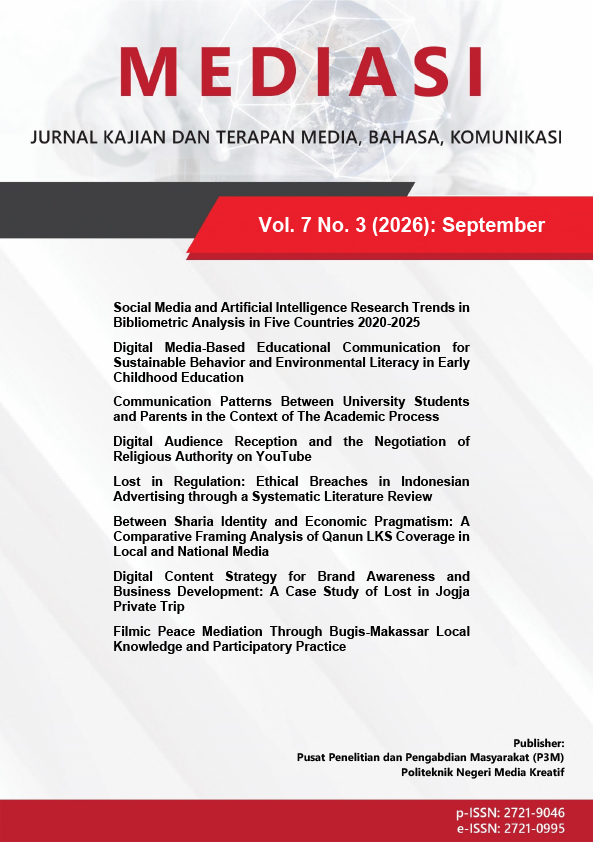
Lost in Regulation: Ethical Breaches in Indonesian Advertising through a Systematic Literature Review
DOI:
https://doi.org/10.46961/mediasi.v7i3.2171Keywords:
Advertising Ethics, Indonesian Advertising Ethics (EPI), Niklas Luhmann’s Social Systems Theory, Systematic Literature Review, Ethical ViolationsAbstract
This article examines how criticism of advertising has been discussed in Indonesian communication scholarship and how these critiques can be mapped onto the Indonesian Advertising Ethics (Etika Pariwara Indonesia/EPI). Using a systematic literature review, this study analyzed 123 peer-reviewed journal articles published between 2004 and 2023 in SINTA-indexed Indonesian communication journals. The search used the keywords “komunikasi pemasaran,” “marketing communication,” “advertising,” “advertisement,” “periklanan,” and “iklan,” followed by manual screening of titles, abstracts, and full texts. The findings identify ten dominant themes: exploitation of gender and sexuality, discrimination and social representation bias, power domination and capitalism, advertising camouflage and blurring boundaries, commodification of religion, visual manipulation and hyperreality, inappropriate advertising for children, misleading information, exaggerated claims and puffery, and intrusive digital advertising. These themes can be mapped onto EPI provisions concerning women, gender, pornography and pornoaction, religion and culture, halal claims, children, misleading language, product benefits, hyperbole, embedded advertising, digital media, privacy, and database practices. However, EPI has been explicitly and systematically used as an analytical framework in only a limited number of studies. Most articles criticize advertising through semiotics, gender studies, cultural studies, political economy, media sociology, or discourse analysis without operationalizing EPI as the primary framework. Drawing on Niklas Luhmann’s Social Systems Theory, this article interprets this pattern as limited resonance between professional self-regulation and academic observation.
References
Adila, W., Nur, L. A., Shabrina, F. R., Prameswary, Y. N., Febiyanti, R., Amalia, A. H., . . . Nurlitasar, R. (2023). Sponsored by: Advertisements as intrusive narratives in Indonesian sinetron. Bricolage: Jurnal Magister Ilmu Komunikasi, 9(2), 163-174. https://doi.org/10.30813/bricolage.v9i2.4541
Andrews, J. C., & Shimp, T. A. (2018). Advertising, Promotion, and other aspects of Integrated Marketing Communications (10 ed.). Boston: Cengage Learning.
Ansari, J., & Hyder, S. (2023). Instrument validation of the consumers’ religio-spiritual insights in context of advertising during religious festivals. Journal of Islamic Marketing, 15(2), 518-540. https://doi.org/10.1108/JIMA-06-2022-0162
Arbak, S., Islam, R., & Al Rasyid, H. (2019). Influence of Islamic Advertising: Ethic Violation on Customer Purchase Intention of Halal Cosmetic Products in Malaysia. Humanities & Social Sciences Reviews, 7(3), 671-682. https://doi.org/10.18510/hssr.2019.7398
Arens, W. F., & Weigold, M. F. (2017). M: ADVERTISING (3rd ed.). New York: McGraw-Hill Education.
Arnie, M., Maryani, E., & Aristi, N. (2017). REPRESENTASI LAKI-LAKI METROSEKSUAL DALAM IKLAN VASELINE MEN FACE MOISTURIZER. Jurnal Manajemen Komunikasi, 2(1), 10-17. https://doi.org/10.24198/jmk.v2i1.21277
Astuti, S. I. (2017). Educating Youth Against Tobacco Advertising: A Media Literacy Approach for Reducing Indonesia's Replacement Smokers. MediaTor Jurnal Komunikasi, 10(1), 65-74. https://doi.org/10.29313/mediator.v10i1.2677
Azwar, K., & Junaedi, F. (2019). Analisis Isi Pelanggaran Etika Pariwara Indonesia Dalam Iklan Baris Dan Iklan Kolom Di Surat Kabar Harian Lombok Post Periode Juni – Juli 2019. Komuniti: Jurnal Komunikasi dan Teknologi Informasi, 11(2), 143-152. https://doi.org/10.23917/komuniti.v12i2.10552
Bazarcı, S. (2022). The effects of different developments in advertising: An overview of American advertising. In I. Krom, Handbook of Research on Global Perspectives on International Advertising (pp. 50-69). IGI Global. https://doi.org/10.4018/978-1-7998-9672-2.ch004
Belch, G. E., & Belch, M. A. (2021). Advertising and Promotion: An Integrated Marketing Communications Perspective (12 ed.). New York: McGraw-Hill Education.
Campbell, C., & Grimm, P. (2018). The Challenges Native Advertising Poses: Exploring Potential Federal Trade Commission Responses and Identifying Research Needs. Journal of Public Policy & Marketing, 38(1), 110-123. https://doi.org/10.1177/0743915618818576
Chuan, C.-H., Tsai, W.-H., & Yang, J. (2023). Artificial Intelligence, Advertising, and Society. Advertising & Society Quarterly, 34(3). https://doi.org/10.1353/asr.2023.a911198
Clow, K. E., & Baack, D. (2022). Integrated Advertising, Promotion, and Marketing Communications (9th - Global ed.). Essex: Pearson Education Limited.
Darmawan, C., & Perdana, I. H. (2026). Autopoiesis and Creativity: Understanding Artificial Intelligence’s Disruption in Advertising Communication. Proceedings of the International Conference on Communication and New Media Studies (COMNEWS 2025). Malacca: Atlantis Press. https://doi.org/10.2991/978-2-38476-573-7_9
Dewan Periklanan Indonesia. (2020). Etika Pariwara Indonesia - Amandemen 2020. Jakarta: Dewan Periklanan Indonesia.
Dinanti, C. D., & Hadi, S. P. (2021). Analisis Native Advertising Sebagai Konten Media Online Dreamers.id. Demandia - Jurnal Desain Komunikasi Visual, Manajemen Desain dan Periklanan, 6(1), 166-193. https://doi.org/10.25124/demandia.v6i1.3424
Dyer, G. (2008). Advertising as communication. Routledge. https://doi.org/10.4324/9780203158340
El Ghiffary, L., & Widana, G. O. (2023). Semiotic Analysis of the Commodification of Islamic Teachings in Sharia Bank Advertisements in Indonesia. Nyimak Journal of Communication, 7(2), 275-296. https://doi.org/10.31000/nyimak.v7i2.9014
Farrell, T. (2012). Controversial advertising in the UK: its regulation and practitioner ethical decision making. The Open University. https://doi.org/10.21954/ou.ro.0000d503
Feenstra, R. A., & Esteban, E. G. (2019). Autocontrol: A Critical Study of Achievements and Challenges in the Pursuit of Ethical Advertising Through an Advertising Self-Regulation System. Journal of Business Ethics, 154(2), 341-354. https://doi.org/10.1007/s10551-016-3423-0
Fernandez, P. W. (2011). Komodifikasi Perempuan dalam Iklan Televisi. Jurnal Ilmu Komunikasi, 8(1), 60-80. https://doi.org/10.24002/jik.v8i1.182
Floridi, L. (2021). The End of an Era: from Self-Regulation to Hard Law for the Digital Industry. Philosophy & Technology, 34, 619-622. https://doi.org/10.1007/s13347-021-00493-0
Gao, B., Wang, Y., Xie, H., Hu, Y., & Hu, Y. (2023). Artificial Intelligence in Advertising: Advancements, Challenges, and Ethical Considerations in Targeting, Personalization, Content Creation, and Ad Optimization. SAGE Open, 13(4). https://doi.org/10.1177/21582440231210759
Gough, D., Oliver, S., & Thomas, J. (2017). An Introduction to Systematic Reviews (2nd ed.). SAGE Publications Inc. Retrieved from https://uk.sagepub.com/sites/default/files/upm-assets/81596_book_item_81596.pdf
Hotkar, P., Garg, R., & Sussman, K. (2023). Strategic social media marketing: An empirical analysis of sequential advertising. Production and Operations Management, 32(12), 4005-4020. https://doi.org/10.1111/poms.14075
Huth, L. (1995). A System Theory's Approach to Advertising. Kurgu Dergisi, 13(1), 211-240. Retrieved from https://dergipark.org.tr/en/download/article-file/1501220
Jesson, J., Matheson, L., & Lacey, F. (2011). Doing Your Literature Review: Traditional and Systematic Techniques. SAGE Publications.
Joaquin, J., & Biana, H. (2020). Sustainability science is ethics: Bridging the philosophical gap between science and policy. Resources, Conservation and Recycling, 160. https://doi.org/10.1016/j.resconrec.2020.104929
Jones, V. K., Johnson, K., Molskness, H., Gandhi, R., & Zhou, L. (2022). Educating Students About Influencing Audiences Ethically in a Data-Driven Social Media World. Journal of Advertising Education, 26(2), 106-114. https://doi.org/10.1177/10980482221127456
Judijanto, L., Utama, A., & Setiyawan, H. (2025). Implementation of Ethical Artificial Intelligence Law to Prevent the Use of AI in Spreading False Information (Deepfake) in Indonesia. The Easta Journal Law and Human Rights, 3(2), 101-109. https://doi.org/10.58812/eslhr.v3i02.470
Karimah, K., Syafitri, P., & Wahyudin, U. (2019). Etika praktik product placement dalam film Ayat-Ayat Cinta 2. Jurnal Manajemen Komunikasi, 4(1), 60-81. https://doi.org/10.24198/jmk.v4i1.23478
Kitsa, M., & Mudra, I. (2019). Gender stereotypes of women in television advertising in Ukraine. Feminist Media Studies, 20(3), 381-397. https://doi.org/10.1080/14680777.2019.1574857
Kopf, D., Torres, I., & Enomoto, C. (2011). Advertising's unintended consequence: Economic growth. Journal of Advertising, 40(4), 5-18. https://doi.org/10.2753/JOA0091-3367400401
Kramp, L., & Loosen, W. (2018). The Transformation of Journalism: From Changing Newsroom Cultures to a New Communicative Orientation? In A. Hepp, A. Breiter, & U. Hasebrink (Eds.), Communicative Figurations: Transforming Communications in Times of Deep Mediatization (Transforming Communications – Studies in Cross-Media Research ed., pp. 205-239). Palgrave Macmillan. https://doi.org/10.1007/978-3-319-65584-0_9
Littell, J., Corcoran, J., & Pillai, V. (2008). Systematic Reviews and Meta-Analysis. Oxford University Press. https://doi.org/10.1093/acprof:oso/9780195326543.001.0001
Livas, C. (2020). The Powers and Perils of Societal Advertising. Journal of Macromarketing, 41(3), 454-470. https://doi.org/10.1177/0276146720978261
Luhmann, N. (1995). Social Systems. (J. Bednarz Jr , & D. Baecker, Trans.) Stanford University Press.
Luhmann, N. (2000). The Reality of the Mass Media. (K. Cross, Trans.) Stanford: Stanford University Press.
Luhmann, N. (2013). Introduction to Systems Theory. Polity Press.
Mandjusri, A. (2017). Klaim Halal Dan Makna Hijrah Pada Iklan Produk Halal Dalam Perspektif Ibu-Ibu Muslimah. Avant Garde, 5(2), 42-68. https://doi.org/10.36080/avg.v5i2.625
McDonald, R. E., Laverie, D. A., & Manis, K. T. (2020). The Interplay between Advertising and Society: An Historical Analysis. Journal of Macromarketing, 41(4), 585-609. https://doi.org/10.1177/0276146720964324
Moitra, R., Purohit, N., & Bhattacharjee, A. (2022). Advertising Ethics: Towards a Stakeholder Approach. PURUSHARTHA - A journal of Management, Ethics and Spirituality, 15(1), 142-158. https://doi.org/10.21844/16202115111
Moriarty, S., Mitchell, N., Wood, C., & Wells, W. (2019). Advertising & IMC: Principles & Practice (11 ed.). New York: Pearson.
Mutahir, A., Chusna, A., & Rizkydarajat, W. (2019). Analisis Kelas Sosial Dalam Membaca Iklan. Profetik Jurnal Komunikasi, 12(2), 212-231. https://doi.org/10.14421/pjk.v12i2.1678
Page, M., Bossuyt, P., Boutron, I., Hoffmann, T., Mulrow, C., Shamseer, L., . . . Moher, D. (2021). The PRISMA 2020 statement: an updated guideline for reporting systematic reviews. The BMJ. https://doi.org/10.1136/bmj.n71
Pasandaran, C. C. (2018). Political Advertising Camouflage As News. Jurnal Komunikasi ISKI, 3(2), 91-98. https://doi.org/10.25008/jkiski.v3i2.219
Patole, S. (2021). Principles and Practice of Systematic Reviews and Meta-Analysis. Springer Cham. https://doi.org/10.1007/978-3-030-71921-0
Perdana, I. H. (2022). Indonesian Advertising Ethics: Guard of Industry & Protector of Advertising Consumer in Indonesia (Study Case of the Role and Function of the Advertising Regulatory Agency on the 2020 Indonesian Advertising Ethics Amendment). The 2nd International Conference on Communication Science (ICCS 2022). Mataram: The Communication Science Department of the University of Mataram. https://doi.org/10.29303/iccsproceeding.v2i1.52
Perelló-Oliver, S., & Muela-Molina, C. (2014). Advertising self-regulation. A comparative analysis between the United Kingdom and Spain. Communication & Society, 27(3), 1-18. https://doi.org/10.15581/003.27.35983
Petticrew, M., & Roberts, H. (2006). Systematic Reviews in the Social Sciences: A Practical Guide. Blackwell Publishing. https://doi.org/10.1002/9780470754887
Ruckenstein, M., & Granroth, J. (2019). Algorithms, advertising and the intimacy of surveillance. Journal of Cultural Economy , 13(1), 12-24. https://doi.org/10.1080/17530350.2019.1574866
Schauster, E. (2019). Ethics Versus Survival: The Relationship Between Advertising Ethics and New Business Challenges. Journal of Current Issues & Research in Advertising, 40(1), 90-104. https://doi.org/10.1080/10641734.2018.1500320
Singhal, A. (2024). The Role of Artificial Intelligence in Enhancing Ad Personalization: A Study on Programmatic Advertising. Journal of Artificial Intelligence General Science, 3(1), 431-445. https://doi.org/10.60087/jaigs.v3i1.246
Tikhomirova, L., Danilevskaya, N., Bazhenova, E., Kyrkunova, L., & Ovsyannikova, S. (2015). Role of the Structure of Public Service Advertising Text in Influencing its Recipient. The Social Sciences, 10(6), 1371-1374. https://doi.org/10.36478/sscience.2015.1371.1374
Trijayanto, D. (2017). Women Representation in Indonesian Media. ULTIMA COMM Jurnal Ilmu Komunikasi, 9(1), 69-78. https://doi.org/10.31937/ultimacomm.v9i1.876
Vukmirović, J., Maričić, L., Stanojevic, S., Vukmirović, A., & Mandić, I. (2025). Considering the ethical aspects of artificial intelligence application from the consumer perspective. BizInfo Blace, 16(1), 1-9. https://doi.org/10.71159/bizinfo250001V
Wicaksono, I. P. (2012). Representasi Eksploitasi Perempuan dalam Iklan. Jurnal Ilmu Komunikasi, 9(2), 149-167. https://doi.org/10.24002/jik.v9i2.171
Widiastuti, T., Prihantoro, E., & Herna. (2023). Commodifying Women in the Digital Creativity Sphere of Political Marketing Communication. Expose: Jurnal Ilmu Komunikasi, 6(1), 69-81. https://doi.org/10.33021/exp.v6i1.4469
Yanti, A. D. (2016). Media dan Gender: Studi Deskriptif Representasi Stereotipe Perempuan dalam Iklan di Televisi Swasta. Profetik Jurnal Komunikasi, 9(2), 26-32. https://doi.org/10.14421/pjk.v9i2.1205
Yanti, N., & Gusfa, H. (2022). Pengaruh brand ambassador Hamish Daud dan iklan terhadap brand image Clear. Jurnal Manajemen Komunikasi, 6(2), 263-280. https://doi.org/10.24198/jmk.v6i2.34802
Zhao, X., & Belk, R. (2008). Politicizing Consumer Culture: Advertising's Appropriation of Political Ideology in China's Social Transition. Journal of Consumer Research, 35(2), 231–244. https://doi.org/10.1086/588747
Downloads
Published
How to Cite
Issue
Section
Citation Check
License
Copyright (c) 2026 Inco Hary Perdana, Helga Liliani Cakra Dewi

This work is licensed under a Creative Commons Attribution 4.0 International License.
You are free to:
- Share — copy and redistribute the material in any medium or format for any purpose, even commercially.
- Adapt — remix, transform, and build upon the material for any purpose, even commercially.
- The licensor cannot revoke these freedoms as long as you follow the license terms.