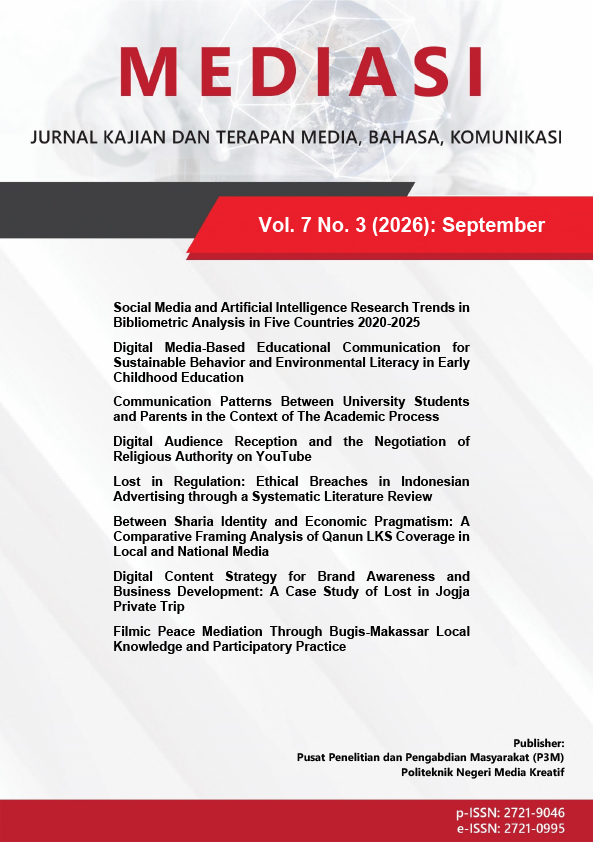
Digital Media-Based Educational Communication for Sustainable Behavior and Environmental Literacy in Early Childhood Education
DOI:
https://doi.org/10.46961/mediasi.v7i3.2025Keywords:
Educational communication, Early childhood education, Environmental literacy, Digital media, Sustainable behaviorAbstract
Environmental literacy and sustainable behavior should be cultivated from early childhood, yet limited research has examined how educational communication mediates the relationship between digital media and children's behavioral development. This study investigates the role of digital media-supported educational communication in fostering environmental literacy and sustainable behavior among young children. A qualitative action research design was employed, comprising four stages: planning, action implementation, observation, and reflection. Data were collected through classroom observations, semi-structured interviews with teachers, and documentation of learning activities, with credibility strengthened through methodological triangulation. The findings show that Canva-based digital learning media enhanced children's engagement, attention, and understanding of environmental concepts. However, digital media alone did not directly foster sustainable behavior. Instead, behavioral change emerged through teachers' educational communication, including persuasive interaction, role modeling, repeated habituation, and continuous reinforcement supported by parental involvement. Teachers functioned as meaning makers who transformed digital content into meaningful learning experiences and encouraged environmentally responsible behavior. This study proposes the Digital Sustainable Communication Ecosystem for Children (DSCEC), a conceptual framework integrating digital media, educational communication, behavioral habituation, and school-parent collaboration to promote sustainable behavior in early childhood education. The findings shift the emphasis from technology-centered learning toward communication-centered digital pedagogy and offer theoretical and practical implications for environmental education and Education for Sustainable Development (ESD).
References
Fadillah, D., Farihanto, M. N., & Setiawan, R. A. D. (2022). “Senggol Bestie” as Media Promotion Among Muhammadiyah Universities. Komunikator, 14(2), 148–158. https://doi.org/10.18196/jkm.15845
Garaigordobil, M., Berrueco, L., & Celume, M.-P. (2022). Developing Children’s Creativity and Social-Emotional Competencies through Play: Summary of Twenty Years of Findings of the Evidence-Based Interventions “Game Program.” Journal of Intelligence, 10(4), 77. https://doi.org/10.3390/jintelligence10040077
Ijar, S., Lu’lu R., Nur S., Fatimah, Khadijah., & Hairani A. P. (2024). Mengembangkan Sosial Emosional Anak Usia Dini Melalui Bermain. Ta’rim: Jurnal Pendidikan Dan Anak Usia Dini, 5(3), 63–71. https://doi.org/10.59059/tarim.v5i3.1340
Jane, F. Nakato, Chidinma I. Onyeibor, & Chinyere E. Ekanem. (2025). Rethinking learner-centered teaching in early education: Lessons from a global practice perspective. International Journal of Management & Entrepreneurship Research, 7(5), 413–420. https://doi.org/10.51594/ijmer.v7i5.1929
Kaya, V. H., & Elster, D. (2019). A Critical Consideration of Environmental Literacy: Concepts, Contexts, and Competencies. Sustainability, 11(6), 1581. https://doi.org/10.3390/su11061581
Kurniawan, Y. I., & Kusuma, A. F. S. (2021). Aplikasi Augmented Reality untuk Pembelajaran Salat bagi Siswa Sekolah Dasar. Jurnal Teknologi Informasi Dan Ilmu Komputer, 8(1), 7. https://doi.org/10.25126/jtiik.0812182
Laksana, D. J., Budiman, A., & Apriandari, W. (2021). Game Edukasi Pengenalan Alat Musik Tradisional Menggunakan Metode MDLC Berbasis Android. Jutisi : Jurnal Ilmiah Teknik Informatika Dan Sistem Informasi, 10(1), 45. https://doi.org/10.35889/jutisi.v10i1.579
Masykuroh, K., & Wahyuni, T. (2023). Media Pop-Up Book Untuk Meningkatkan Karakter Peduli Lingkungan Pada Anak Usia Dini. Aulad: Journal on Early Childhood, 6(2), 172–181. https://doi.org/10.31004/aulad.v6i2.483
Mayer, R. E., & Moreno, R. (1998). A split-attention effect in multimedia learning: Evidence for dual processing systems in working memory. Journal of Educational Psychology, 90(2), 312–320. https://doi.org/10.1037/0022-0663.90.2.312
Moreno, R., & Mayer, R. E. (1999). Cognitive principles of multimedia learning: The role of modality and contiguity. Journal of Educational Psychology, 91(2), 358–368. https://doi.org/10.1037/0022-0663.91.2.358
Muldoon, R., Shelford, T., Holland, O., & Hryciw, D. H. (2019). Environmental Awareness of Primary School Aged Children in Brisbane, Australia. International Journal of Innovation in Science and Mathematics Education, 27(2). https://doi.org/10.30722/IJISME.27.02.003
Ningrum, F. S., Safrina, R., & Sumadi, T. (2021). Peran Pembelajaran Musik melalui Project Based Learning terhadap Perilaku Sosial Anak Usia 5-6 Tahun. Jurnal Obsesi : Jurnal Pendidikan Anak Usia Dini, 6(2), 704–718. https://doi.org/10.31004/obsesi.v6i2.1559
Nunneley, C. E., Fishman, M., Sundheim, K. M., Korus, R. E., Rosen, R. H., Streater, B. A., O’Donnell, K. A., Newman, L. R., & Marcus, C. H. (2021). Leading synchronous virtual teaching sessions. The Clinical Teacher, 18(3), 231–235. https://doi.org/10.1111/tct.13282
Pramadita, S. (2021). Potensi Daur Ulang Sampah Melalui Identifikasi Jenis Dan Karakteristik Sampah Di Panti Asuhan Dan Pesantren Darul Khairat. Jurnal Teknologi Lingkungan Lahan Basah, 9(2), 082–089. https://doi.org/10.26418/jtllb.v9i2.47598
Pramono, R.-, Cendana, W., M. Panjaitan, A., Siahaan, H., & Sekar Syallomitha, D. (2024). Gerakan Literasi Cinta Lingkungan Melalui Pojok Baca Masyarakat. Prosiding Konferensi Nasional Pengabdian Kepada Masyarakat Dan Corporate Social Responsibility (PKM-CSR), 6, 1–5. https://doi.org/10.37695/pkmcsr.v6i0.2022
Putri, H. R. (2022). Pembentukan Karakter Cinta kepada Tuhan dan Cinta Kepada Lingkungan pada Anak Usia Dini (AUD) melalui Pembiasaan dan Keteladanan. BIO-CONS : Jurnal Biologi Dan Konservasi, 4(2), 151–156. https://doi.org/10.31537/biocons.v4i2.720
Rojo-Ramos, J., Manzano-Redondo, F., Barrios-Fernandez, S., García-Gordillo, M. A., & Adsuar, J. C. (2021). Early Childhood Education Teachers’ Perception of Outdoor Learning Activities in the Spanish Region of Extremadura. Sustainability, 13(16), 8986. https://doi.org/10.3390/su13168986
Rosyida, E., Listiyono, H., & Zuliarso, E. (2024). Rancang Bangun Game Edukasi Pembelajaran Huruf Alfabet Pada Anak Usia Dini Menggunakan Metode Multimedia Development Life Cycle. Jurnal JTIK (Jurnal Teknologi Informasi Dan Komunikasi), 8(3), 549–555. https://doi.org/10.35870/jtik.v8i3.2014
Sari, E. A., Setiawan, R. A. D., & Jandevi, U. (2023). Social Media in Electoral Communication: A Case Study of Strategic Initiatives by Bantul Election Commission for the 2024 Elections. CHANNEL: Jurnal Komunikasi, 11(2), 137–143. https://doi.org/10.12928/channel.v11i2.377
Setyaningsih, D., Handasah, R. R., Mamma, A. T., Krobo, A., Olua, E., & Iryouw, V. (2024). Fostering Eco-literacy and Naturalistic Intelligence through Environmentally Based Education in Coastal Preschool. JPUD - Jurnal Pendidikan Usia Dini, 18(1), 251–269. https://doi.org/10.21009/JPUD.181.18
Siregar, M., Meilanie, S. M., & Purwanto, A. (2020). Pengenalan Ecoliteracy pada Anak Usia Dini melalui Metode Bercerita. Jurnal Obsesi : Jurnal Pendidikan Anak Usia Dini, 5(1), 719. https://doi.org/10.31004/obsesi.v5i1.700
Supriani, Y., Oktaviyanthi, R., & Suherman, S. (2024). Peran Orang Tua dalam Pengenalan Angka di Era Digital Melalui Comic Digital Interaktif. Jurnal Sosial Dan Sains, 4(10), 966–975. https://doi.org/10.59188/jurnalsosains.v4i10.19997
Turnure, C. (1975). Cognitive development and role-taking ability in boys and girls from 7 to 12. Developmental Psychology, 11(2), 202–209. https://doi.org/10.1037/h0076456
Xu, L., Ling, M., Lu, Y., & Shen, M. (2017). Understanding Household Waste Separation Behaviour: Testing the Roles of Moral, Past Experience, and Perceived Policy Effectiveness within the Theory of Planned Behaviour. Sustainability, 9(4), 625. https://doi.org/10.3390/su9040625
Zou, B.-J. (2017). Understanding American Preschool Teachers’ Teaching Beliefs About Literacy Instruction. DEStech Transactions on Social Science, Education and Human Science, mess. https://doi.org/10.12783/dtssehs/mess2017/12153
Downloads
Published
How to Cite
Issue
Section
Citation Check
License
Copyright (c) 2026 Eka Anisa Sari, Dhias Cahya Hakika, Anissa Yuwantina, Resdika Anggesa Dwi Setiawan, Angga Pranata

This work is licensed under a Creative Commons Attribution 4.0 International License.
You are free to:
- Share — copy and redistribute the material in any medium or format for any purpose, even commercially.
- Adapt — remix, transform, and build upon the material for any purpose, even commercially.
- The licensor cannot revoke these freedoms as long as you follow the license terms.