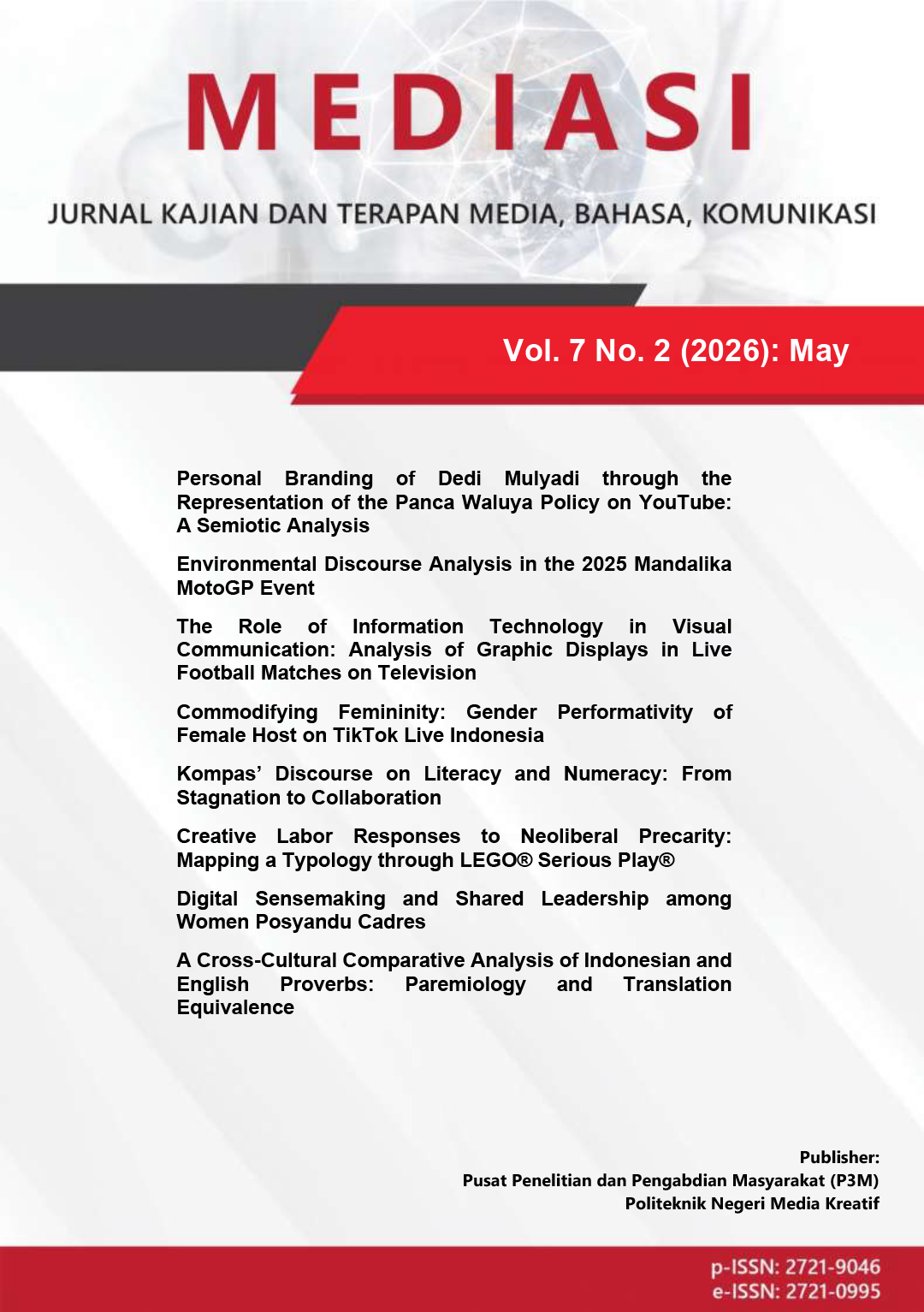
Digital Sensemaking and Shared Leadership among Women Posyandu Cadres
DOI:
https://doi.org/10.46961/mediasi.v7i2.2030Keywords:
Digital Sensemaking, Organizational Information Theory, Posyandu, Shared Leadership, WhatsApp CommunicationAbstract
Community-based health volunteer organizations have emerged as critical yet undertheorized sites of organizational communication, particularly in the Global South. This study examines how digital sensemaking processes contribute to the emergence of shared leadership among women Posyandu cadres in Pejaten Barat, South Jakarta, Indonesia. Adopting a qualitative case study design, data were collected through in-depth interviews, non-participant observation, and document analysis involving six cadres at Posyandu Nangka II. Guided by Weick's Organizational Information Theory and the shared leadership framework, the study analyzes how cadres interpret, negotiate, and retain organizational information through both face-to-face interaction and WhatsApp-mediated communication. The findings demonstrate that WhatsApp functions not merely as a message channel but as a digital sensemaking arena, enabling cadres to reduce equivocality, coordinate activities, and construct shared understandings of tasks and responsibilities. These processes facilitate the distribution of leadership functions beyond formal hierarchical structures, allowing active members to assume coordination and decision-making roles when formal leadership is absent or passive. The study argues that shared leadership in this context emerges through continuous communicative practices rather than formal authority. The novelty of this study lies in extending Weick's sensemaking framework into digitally mediated, women-led volunteer settings a context that has received limited attention in organizational communication research. Findings offer practical insights for strengthening women's participation, coordination, and leadership capacity in community-based health programs through digital communication platforms.
References
Banjarnahor, A. R., Handiman, S. P. U. T., Sesilia, A. P., Kato, S. S. I., Purba, A. T. L., Sahir, S. H., Widarman, A., Bonaraja, D. G., & Sianipar, J. H. (2022). Dasar komunikasi organisasi. Yayasan Kita Menulis.
Bouhnik, D., & Deshen, M. (2014). WhatsApp goes to school: Mobile instant messaging between teachers and students. Journal of Information Technology Education: Research, 13, 217–231. https://doi.org/10.28945/2051
Carson, J. B., Tesluk, P. E., & Marrone, J. A. (2007). Shared leadership in teams: An investigation of antecedent conditions and performance. Academy of Management Journal, 50(5), 1217–1234. https://doi.org/10.2307/20159921
Church, K., & de Oliveira, R. (2013). What's up with WhatsApp? Comparing mobile instant messaging behaviors with traditional SMS. Proceedings of the 15th International Conference on Human-Computer Interaction with Mobile Devices and Services, 352–361. https://doi.org/10.1145/2493190.2493225
Creswell, J. W., & Poth, C. N. (2018). Qualitative inquiry and research design: Choosing among five approaches (4th ed.). SAGE Publications.
D'Innocenzo, L., Mathieu, J. E., & Kukenberger, M. R. (2016). A meta-analysis of different forms of shared leadership–team performance relations. Journal of Management, 42(7), 1964–1991. https://doi.org/10.1177/0149206314525205
Fajriyah, N., Ri'aeni, I., & Yusron, A. (2023). Efektivitas komunikasi organisasi dalam manajemen program kerja pos yandu. Jurnal InterAct, 8(1), 16–25. https://ejournal.atmajaya.ac.id/index.php/interact/article/view/3996
Fitri, A., Alfahira, N., & Hayati, F. (2022). Membangun kerja sama tim dalam perilaku organisasi. Journal Research and Education Studied, 2(2), 103–109.
Ganasegeran, K., Abdulrahman, S. A., Mahfudz, A. A., Al-Dubai, S. A. R., Aljunid, S. M., & Looi, I. (2017). Mobile health: A technology adoption perspective in Malaysian healthcare. Global Journal of Health Science, 9(2), 1–9. https://doi.org/10.5539/gjhs.v9n2p1
Ghannam, J. (2018). Social media in the Arab world: Leading up to the uprisings of 2011. Center for International Media Assistance.
Hoch, J. E., & Kozlowski, S. W. J. (2014). Leading virtual teams: Hierarchical leadership, structural supports, and shared team leadership. Journal of Applied Psychology, 99(3), 390–403. https://doi.org/10.1037/a0030264
Julianti, U. F., & Oktavianty, M. (2025). Faktor-faktor yang mempengaruhi keaktifan kader dalam pelaksanaan Posyandu. Journal of Nursing Practice and Education, 5(2), 194–200. https://doi.org/10.34305/jnpe.v5i2.1636
Kementerian Dalam Negeri Republik Indonesia. (2011). Pedoman pengintegrasian layanan sosial dasar di pos pelayanan terpadu: Peraturan Menteri Dalam Negeri Nomor 19 Tahun 2011.
Kementerian Kesehatan Republik Indonesia. (2011). Pedoman umum pengelolaan posyandu. Kemenkes RI.
Khomsahrial, R. (2015). Komunikasi organisasi lengkap. Grasindo.
Morissan. (2020). Komunikasi organisasi (1st ed.). Kencana Prenada Media Group.
Novrianti, L., & Achmadi. (2021). Pengaruh komunikasi kelompok kader posyandu dan komunitas ibu-ibu terhadap minat mengunjungi posyandu terkait isu diharamkannya vaksin measles rubella. Intercode Jurnal Ilmu Komunikasi, 1(1), 13–34.
Pace, R. W., & Faules, D. F. (2019). Komunikasi organisasi: Strategi meningkatkan kinerja perusahaan. Remaja Rosdakarya.
Pearce, C. L., & Conger, J. A. (Eds.). (2003). Shared leadership: Reframing the hows and whys of leadership. SAGE Publications. https://doi.org/10.4135/9781452229539
Rohmani, N., & Utari, D. (2022). The role of leadership and its relationship with the performance of community health volunteer: A survey in rural Indonesia. Disease Prevention and Public Health Journal, 15(2), 103. https://doi.org/10.12928/dpphj.v15i2.4194
Semaan, B., Mark, G., & Al-Ani, B. (2014). An examination of social media in the Arab world. First Monday, 19(2). https://doi.org/10.5210/fm.v19i2.4504
Silalahi, M., Inrawan, A., Putri, J. A., Indajang, K., & Sudirman, A. (2023). Increasing motivation and teamwork to encourage services for Posyandu cadres in the City of Pematang Siantar. Jurnal Pengabdian Nasional (JPN) Indonesia, 4(1), 196–203. https://doi.org/10.35870/jpni.v4i1.144
Sri Agustina, D., & Bahtiar, D. (2025). Penguatan manajemen inovasi posyandu melalui komunikasi persuasif: Peran kader dalam meningkatkan partisipasi ibu hamil dan balita. Jurnal Minfo Polgan, 14(1), 1458–1466. https://doi.org/10.33395/jmp.v14i1.15081
Strauss, A., & Corbin, J. (1998). Basics of qualitative research: Techniques and procedures for developing grounded theory (2nd ed.). SAGE Publications.
Sulaeman, S. (2022). Hubungan motivasi dan keaktifan kader terhadap kinerja kader posyandu pada masa pandemi COVID-19. Indonesian Journal of Professional Nursing, 3(1), 1. https://doi.org/10.30587/ijpn.v3i1.3964
Sulistira, A. N. F., Qoblia, P. I., & Rizki, T. S. (2023). Peran komunikasi penerimaan aktif dalam membangun kerja sama tim dalam organisasi. Lenvari: Journal of Social Science, 1(1), 33–39. https://doi.org/10.61105/jss.v1i1.22
Wang, D., Waldman, D. A., & Zhang, Z. (2014). A meta-analysis of shared leadership and team effectiveness. Journal of Applied Psychology, 99(2), 181–198. https://doi.org/10.1037/a0034531
Weick, K. E. (1979). The social psychology of organizing (2nd ed.). Addison-Wesley.
Weick, K. E., & Sutcliffe, K. M. (2015). Managing the unexpected: Sustained performance in a complex world. John Wiley & Sons.
Yates, J., & Orlikowski, W. J. (1992). Genres of organizational communication: A structurational approach to studying communication and media. Academy of Management Review, 17(2), 299–326. https://doi.org/10.2307/258774
Yin, R. K. (2018). Case study research and applications: Design and methods (6th ed.). SAGE Publications.
Downloads
Published
How to Cite
Issue
Section
Citation Check
License
Copyright (c) 2026 Meranti Hasbiran, Alifiana Khairunnisa, Annisa Utami Seminar, Amiruddin Saleh, Mimi Fitriana

This work is licensed under a Creative Commons Attribution 4.0 International License.
You are free to:
- Share — copy and redistribute the material in any medium or format for any purpose, even commercially.
- Adapt — remix, transform, and build upon the material for any purpose, even commercially.
- The licensor cannot revoke these freedoms as long as you follow the license terms.