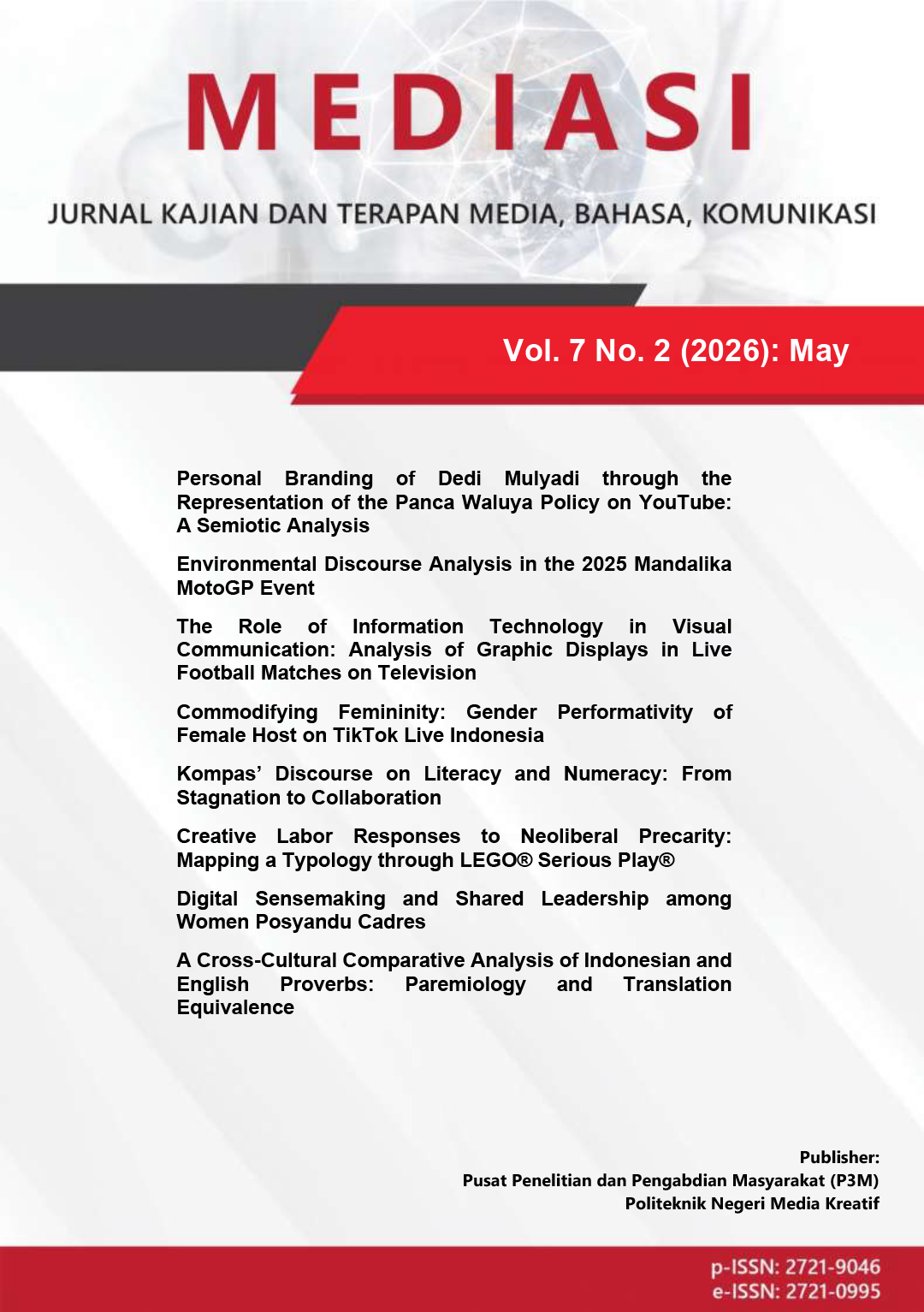
Environmental Discourse Analysis in the 2025 Mandalika MotoGP Event
DOI:
https://doi.org/10.46961/mediasi.v7i2.2038Keywords:
Critical Discourse Analysis, Environmental Discourse, Mandalika MotoGP, Sport Tourism, Waste ManagementAbstract
Environmental and sustainability discourses increasingly shape international sport-tourism events, including the Mandalika MotoGP. This study examines how environmental discourse was constructed in media coverage and stakeholder practices surrounding the 2025 Mandalika MotoGP. Using Fairclough's three-dimensional framework of critical discourse analysis, the study analyzes text, discursive practice, and socio-cultural practice. The data consist of 16 online news articles published by nine local and three national media outlets, complemented by interviews with an event organizer, a sanitation worker, and a spectator. Textual analysis shows that phrases such as clean event, green tourism, circular economy, and sustainable sport tourism framed the event as environmentally responsible. The analysis of discursive practices reveals that local government agencies and event organizers dominated media narratives by emphasizing preparedness, cleanliness programs, volunteer involvement, and circular-economy initiatives in waste management. At the socio-cultural level, interviews confirm that waste collection, sorting, and processing were enacted through collaboration among organizers, companies, sanitation workers, and volunteers. The study's novelty lies in applying Fairclough's framework to an international sport-tourism event rather than to conventional political or environmental news. The findings contribute to environmental communication studies by showing how sustainability discourse can legitimize event-based tourism development while marginalizing alternative community or activist perspectives.
References
Caraka, R. E., Wardhana, I. W., Kim, Y., Sakti, A. D., Gio, P. U., Noh, M., & Pardamean, B. (2023). Connectivity, sport events, and tourism development of Mandalika’s special economic zone: A perspective from big data cognitive analytics. Cogent Business & Management, 10(1), 1–19. https://doi.org/10.1080/23311975.2023.2183565
Cenderamata, R. C., & Darmayanti, N. (2019). Analisis wacana kritis Fairclough pada pemberitaan selebriti di media daring. Jurnal Literasi, 3(1), 1–8. https://doi.org/10.25157/literasi.v3i1.1736
Eikman, A., & Hadi, S. (2022). Mandalika Special Economic Zone and the potential for regional economic development of Central Lombok Regency through investment. Jurnal Economic Resources, 5(2), 321–333. https://doi.org/10.57178/jer.v5i2.371
Firdaus, Y. A., & Firman, H. (2025). Analisis wacana kritis terhadap pernyataan Dedi Mulyadi tentang penghapusan wisuda sekolah: Perspektif Norman Fairclough. RELASI: Jurnal Penelitian Komunikasi, 5(4), 378–388. https://doi.org/10.69957/relasi.v5i04.2276
Hafifi, M. K., & Murdana, I. M. (2024). Pengelolaan sampah dalam pengembangan pariwisata berkelanjutan di destinasi super prioritas - KEK Mandalika. Tourism, Hospitality and Culture Insights Journal, 4(1), 27–39. https://doi.org/10.36983/thcij.v4i1.545
Handayani, N. D., Mailin, Nurfauzy, L., & Hasibuan, W. A. (2022). Analisis wacana Fairclough pada pemberitaan selebgram Rachel Vennya di media daring Tempo.co. Komunikologi: Jurnal Pengembangan Ilmu Komunikasi dan Sosial, 6(2). https://doi.org/10.30829/komunikologi.v6i2.14667
Haryatmoko. (2016). Critical discourse analysis: Analisis wacana kritis, landasan teori, metodologi, dan penerapan. Rajawali Pers.
Indrayanti, T., Rakhmawati, A., & Saddhono, K. (2025). Mengungkap kekuatan retorika dalam pidato Presiden Prabowo Subianto “Singgung Tarif Trump”: Analisis wacana kritis Fairclough. Diglosia, 8(3), 741–754. https://doi.org/10.30872/diglosia.v8i3.1360
Ivosights.com. (2022). MotoGP Mandalika 2022 digital monitoring.
Larasati, M. R. P., Mahadewi, N. M. E., & Surata, I. K. (2023). The role of sports events as an alternative tourism in Lombok: A case study of the implementation of the MotoGP Mandalika. Jurnal Bisnis dan Manajemen, 3(3).
Lestari, A. T., Anwar, H., & Syaputra, M. (2024). Pemetaan dan analisis pengelolaan sampah di Kawasan Ekonomi Khusus (KEK) Mandalika, NTB. Perennial, 20(1), 28–34. https://doi.org/10.24259/perennial.v20i1.32908
Mudiawati, R. C., Hakiki, D. R., Tialani, K. T., & Mulawarman, W. G. (2023). Membingkai solusi berkelanjutan: Analisis wacana kritis Norman Fairclough terhadap diskursus tentang restorasi hutan tropis lembab basah di wilayah Kalimantan. Journal of Educational and Language Research, 2(12). https://doi.org/10.53625/joel.v2i12.6261
Muhlis, Khusnia, H. N., Yohanes, Y. T. S., & Riyayanatasya, Y. W. (2023). Radio dan pengembangan pariwisata: Studi kasus terhadap RRI Mataram dalam mempromosikan MotoGP di Sirkuit Mandalika Lombok 2022. JCommsci: Journal of Media and Communication Science, 6(2), 43–52. https://doi.org/10.29303/jcommsci.v6i2.195
Pauzi, I., & Purwoko, A. A. (2022). Organic waste management in the hospitality area for the development and conservation of ecotourism in the Mandalika Special Economic Zone, Indonesia: Literature review. Path of Science, 8(11), 2010–2015. https://doi.org/10.22178/pos.87-7
Prastya, N. M., Maharani, B. M., & Ningsih, I. N. D. K. (2023). Instagram usage in destination branding through sports event: Study of Mandalika 2021 World Superbike. Bricolage: Jurnal Magister Ilmu Komunikasi, 9(1), 27–39. https://doi.org/10.30813/bricolage.v9i1.3988
Rahmatika, B. D. A., & Murdana, I. M. (2024). Dampak pembangunan wisata sport tourism Pertamina Mandalika International Circuit dalam aspek ekonomi. TEHBMJ: Tourism Economics Hospitality and Business Management Journal, 4(1), 7–12. https://doi.org/10.36983/tehbmj.v4i1.556
Rifki, I., & Sumilih, D. A. (2024). Adaptasi sosial budaya masyarakat Sasak terhadap keberadaan Sirkuit Mandalika di Kabupaten Lombok Tengah Nusa Tenggara Barat. JERP: Jurnal Ekonomi dan Riset Pembangunan, 2(2), 1–10.
Rohullah, B. K., Kholis, M. Z., Basori, B., & NM, N. (2022). Analisis pemberitaan media CNN Indonesia tentang pawang hujan di Sirkuit MotoGP Mandalika. Konferensi Nasional Komunikasi dan Penyiaran Islam, 62–70. https://doi.org/10.19105/knc.v1i1.291
Rosadha, S. A., Putri, R. D. M., Putri, T. A., & Ahmad, N. (2025). Representasi isu lingkungan dalam media arus utama Indonesia: Sebuah analisis wacana kritik. Innovative: Journal of Social Science Research, 5(2). https://doi.org/10.31004/innovative.v5i2.18838
Sayuti, R. H., Taqiuddin, M., Hayati, Evendi, A., Hidayati, S. A., Asri, K. H., & Sopian, E. (2023). Socio-economic mapping for community empowerment in Mandalika special economic zone, Lombok, Indonesia. IOP Conference Series: Earth and Environmental Science, 1253(1). https://doi.org/10.1088/1755-1315/1253/1/012067
Sholikhatun, P., Kusuma, N. T., & Istiqomah, N. (2024). 2022 MotoGP in Indonesia: Atlas.ti analysis of the impact NTB economy. Jurnal Akuntansi Bisnis dan Ekonomi, 10(1), 61–70. https://doi.org/10.33197/jabe.vol10.iss1.2024.1656
Sofian, H., SY, Y. T., Putra, S. J., Rahmat, L. A., & Suryantara, I. M. P. (2022). Analisis agenda setting pemberitaan MotoGP Mandalika pada RRI Mataram. MUKASI: Jurnal Ilmu Komunikasi, 1(1), 11–20. https://doi.org/10.54259/mukasi.v1i1.417
Suleman, D., Supiandi, S., Budi, S., Yuli, S. B. C., Martayadi, U., & Muttaqin, Z. (2023). Balancing cultural shock and economic development: A study of impacts on local culture in the Mandalika Special Economic Zone. Journal of Enterprise and Development, 5(2), 522–534. https://doi.org/10.20414/jed.v5iSpecial-Issue-2.8158
Susila, N. P. S. W., & Isnaini, S. (2023). Strategi public relations Mandalika Grand Prix Association (MGPA) dalam manajemen event World Superbike 2022. Medkom: Jurnal Media dan Komunikasi, 3(2). https://doi.org/10.20473/medkom.v3i2.42163
Widaswara, R. Y. (2022). Analisis wacana Van Dijk pada berita online MotoGP Mandalika dan kebangkitan ekonomi NTB. Waisya: Jurnal Ekonomi, 1(1). https://doi.org/10.53977/jw.v1i1.460
Downloads
Published
How to Cite
Issue
Section
Citation Check
License
Copyright (c) 2026 Suluh Gembyeng Ciptadi, Faridhian Anshari, Dian Nurdiansyah, Narayana Mahendra Prastya

This work is licensed under a Creative Commons Attribution 4.0 International License.
You are free to:
- Share — copy and redistribute the material in any medium or format for any purpose, even commercially.
- Adapt — remix, transform, and build upon the material for any purpose, even commercially.
- The licensor cannot revoke these freedoms as long as you follow the license terms.